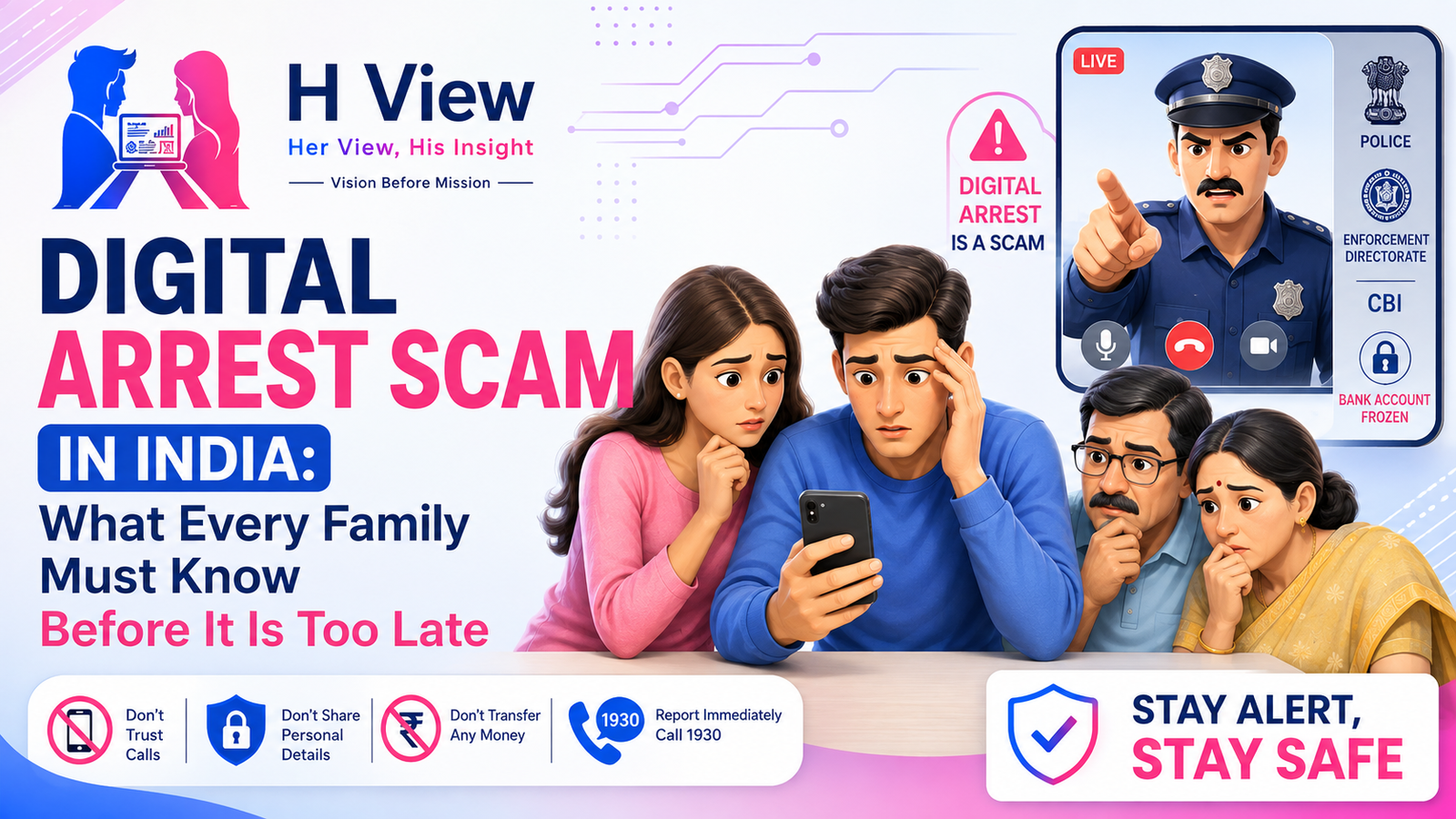
A phone call arrives from someone claiming to be a police officer, customs official, courier investigator or government officer. The caller says your Aadhaar number, mobile connection, bank account or parcel has been linked to money laundering, drugs or another serious crime.
Within minutes, the call becomes a video interrogation.
You may see uniforms, official-looking identity cards, police-station backgrounds, legal documents and government logos. The caller orders you not to disconnect, not to speak to your family and not to leave the room. You are told that you are under “digital arrest” and must transfer money to prove your innocence or allow authorities to verify your bank account.
This entire situation is a scam.
India’s Indian Cybercrime Coordination Centre, or I4C, has explicitly warned that genuine law-enforcement agencies do not conduct arrests through video calls or demand payments for clearing a person’s name. Victims should disconnect, avoid transferring money and report the incident immediately.
What is a digital arrest scam?
A digital arrest scam is a form of cyber-enabled impersonation and psychological manipulation.
The criminal pretends to represent an organisation such as:
- The police
- The Central Bureau of Investigation
- Customs
- The Enforcement Directorate
- The Telecom Regulatory Authority of India
- A courier company
- A bank or financial institution
The scammer falsely accuses the victim of involvement in a crime and uses fear to gain control over the conversation.
The term “digital arrest” is invented by scammers. It is not a recognised legal procedure that allows an officer to confine someone through WhatsApp, Skype, Telegram or any other video-calling platform.
Real authorities may contact citizens during an investigation, but they do not keep people under continuous video surveillance, demand secrecy from family members or ask them to transfer money to a so-called safe, verification or government account.
How the scam usually begins
The first call often appears ordinary.
A caller may say:
“A parcel registered in your name contains illegal items.”
Another version may claim:
“Your mobile number will be disconnected because it was used for criminal activity.”
The victim is then transferred to another person who claims to be a senior police officer or investigator. This second person may know the victim’s name, Aadhaar details, address or other personal information obtained through leaked databases, social media or previous scams.
The caller may then:
- Display a fake police identity card.
- Show a forged arrest warrant or legal notice.
- Conduct a staged video interrogation.
- Tell the victim not to contact anyone.
- Demand access to financial information.
- Order money to be transferred for “verification.”
- Promise that the money will be returned after the investigation.
The objective is not merely to deceive the victim. It is to isolate, frighten and exhaust them until they obey.
Why educated people also fall for it
It is easy to ask why someone would believe such a call. That question underestimates how carefully these scams are designed.
The caller creates immediate fear
Words such as arrest, money laundering, drugs, terrorism and court action can overwhelm a person’s ability to think calmly.
The victim begins reacting to the danger rather than evaluating whether the story makes sense.
The scam looks official
Fraudsters may use uniforms, government logos, forged documents, fake police-station backgrounds and professional language.
A visual presentation can make an invented situation appear legitimate.
The victim is isolated
The caller may say:
- “This investigation is confidential.”
- “Do not tell your family.”
- “You will be arrested if you disconnect.”
- “Anyone you contact may become part of the case.”
Isolation prevents relatives from challenging the scammer’s claims.
The scammer already knows personal information
When a stranger correctly states a victim’s name, phone number or address, the victim may assume the caller has official access.
In reality, personal data can come from breached websites, public profiles, marketing lists, stolen documents or previous fraudulent interactions.
Pressure continues for hours
Some victims are kept on video calls for long periods. Exhaustion, anxiety and repeated threats can reduce independent decision-making.
Falling for such manipulation does not mean the victim lacks intelligence. It means the criminals successfully created fear and prevented outside verification.
Ten warning signs that the call is fraudulent
End the conversation immediately when a caller:
- Claims you are under “digital arrest.”
- Says you must remain visible on a video call.
- Demands that you keep the investigation secret.
- Prevents you from calling family members or a lawyer.
- Asks for bank balances, OTPs, PINs or login credentials.
- Demands money for verification, bail or security.
- Sends a personal or unfamiliar bank account for payment.
- Threatens immediate arrest if you disconnect.
- Uses WhatsApp or another private platform as an interrogation room.
- Refuses to let you independently contact the claimed agency.
I4C’s official advisory makes the central rule clear: genuine law-enforcement authorities do not conduct digital arrests or demand payment through calls of this kind.
What to do during the first ten minutes
Your actions immediately after recognising the scam can reduce the risk of financial loss.
Disconnect the call
Do not continue arguing or trying to prove your innocence.
End the call even when the person threatens arrest. A genuine authority will not treat the disconnection of a private video call as a criminal offence.
Do not transfer money
Never send money to:
- A safe account
- A verification account
- A government security account
- A temporary holding account
- A personal UPI ID
- A cryptocurrency wallet
These descriptions are designed to make theft sound like an official procedure.
Do not reveal confidential information
Never share:
- OTPs
- Debit- or credit-card PINs
- Internet-banking passwords
- UPI PINs
- CVV numbers
- Screen-sharing access
- Remote-control access
- Full bank-account information
Banks and government agencies do not need these credentials to investigate a case.
Contact a trusted person
Call a family member, friend, lawyer or colleague immediately.
Speaking to another person breaks the scammer’s psychological control and allows the claim to be evaluated calmly.
Verify independently
Find the official number of the relevant police department or agency yourself. Do not call a number supplied by the suspicious caller.
A genuine notice can be verified through official channels.
Save evidence
Preserve:
- Phone numbers
- WhatsApp profiles
- Screenshots
- Video-call details
- Messages
- Payment instructions
- Bank-account numbers
- UPI IDs
- Email addresses
- Transaction receipts
Do not delete the conversation before reporting it.
What to do when money has already been transferred
Act immediately. Do not wait until the next morning or spend hours feeling embarrassed.
Call the national cybercrime helpline
Call 1930 and report the financial fraud as quickly as possible.
The National Cybercrime Reporting Portal and I4C state that the 1930 helpline operates across India’s states and Union Territories for reporting cyber financial fraud. Quick reporting may help authorities coordinate with financial institutions before the money moves through additional accounts.
Contact your bank
Inform the bank’s official fraud department immediately.
Provide:
- The transaction reference number
- Amount transferred
- Beneficiary account or UPI ID
- Time of the transaction
- Screenshots and call details
Ask the bank to register a fraud complaint and attempt to hold or trace the transaction.
File an online cybercrime complaint
Submit the details through the Government of India’s National Cyber Crime Reporting Portal.
The portal allows citizens to report cybercrime complaints, including financial fraud, and states that accurate information should be provided to support prompt action by law-enforcement agencies.
Approach the local police
File a complaint with your local police or cybercrime police station, especially when a large amount, identity theft, intimidation or continuing harassment is involved.
Carry copies of all available evidence.
Secure your accounts
When any credentials or device access may have been exposed:
- Change banking and email passwords.
- Block affected cards.
- Reset UPI access.
- Remove unknown applications.
- Disable screen-sharing or remote-access tools.
- Check recent transactions.
- Inform the mobile operator when SIM misuse is suspected.
Use a separate trusted device when you believe the original phone or computer may be compromised.
How scammers target parents and senior citizens
Older family members may be especially vulnerable because they often:
- Trust uniforms and government titles
- Fear legal consequences
- Live alone during the day
- Are less familiar with video-call manipulation
- Hesitate to question supposed authorities
- Keep retirement funds in accessible accounts
- Avoid telling children because of embarrassment
Families should not merely tell parents, “Do not answer unknown calls.” That advice is too general.
Teach them one clear rule:
No police officer, court, bank or government department will ask you to transfer money during a video-call investigation.
Create a family safety system:
- No large transfer without calling one trusted person.
- No OTP or PIN shared on a call.
- No confidential investigation kept secret from the family.
- No remote-access application installed on someone’s instructions.
- Every threatening call must be disconnected and independently verified.
Place the number 1930 somewhere easily visible near the phone.
What genuine authorities generally do differently
A legitimate investigation follows formal legal and administrative processes.
Depending on the circumstances, authorities may issue notices, request a person’s presence, communicate through recognised channels or visit an address. A person can independently verify the officer, police station, case details and official contact information.
A real officer does not need a citizen to move personal savings into an unknown account to establish innocence.
A real investigation also does not depend on preventing the person from speaking with family members or obtaining legal advice.
When uncertain, disconnect and contact the claimed department through a number obtained from its official government website.
Do not trust caller ID, uniforms or documents alone
A phone screen can display misleading information.
Scammers can use:
- Spoofed caller identities
- Fake government email addresses
- Edited identity cards
- Forged warrants
- Recorded police-station sounds
- Virtual backgrounds
- Stolen profile photographs
- Fake seals and letterheads
Therefore, visual evidence presented by the caller should never replace independent verification.
Even when the caller correctly names an official or department, contact that department separately.
What families should avoid saying to victims
Victims often remain silent because they expect blame.
Avoid statements such as:
- “How could you believe this?”
- “You should have known better.”
- “Only careless people fall for scams.”
- “You have lost the family’s money.”
These reactions may delay reporting and reduce the chance of recovering funds.
Instead say:
- “End the call now.”
- “We will report it immediately.”
- “Do not delete anything.”
- “Contact the bank while I call 1930.”
- “We will handle the next steps together.”
The priority is rapid action, not criticism.
Her View
Digital-arrest scams succeed by attacking fear, dignity and family responsibility.
A parent may transfer money because they believe they are protecting their children from a criminal investigation. A working professional may remain silent because the caller warns that informing colleagues will worsen the case.
Families must create an environment where asking for help is never treated as foolishness.
His Insight
The most powerful defence is a verification habit.
Whenever a caller creates urgency, secrecy and financial pressure at the same time, stop the conversation. A genuine institution will allow its identity and request to be verified independently.
Fear demands immediate obedience. Safety requires a pause.
H View recommendation
Every household should discuss digital-arrest scams before receiving such a call.
Save 1930, explain the warning signs to parents and establish a rule that no large or unusual financial transfer will be made without informing another trusted family member.
The central message is simple:
There is no legitimate “digital arrest” conducted through a video call, and innocence is never proved by transferring money.
Frequently asked questions
“Digital arrest,” as used by scammers, is not a legitimate procedure that allows police to confine someone on a video call. I4C warns that genuine law-enforcement agencies do not conduct arrests or demand payments in this manner.
No. A demand to transfer money to prove innocence, protect funds or complete an investigation is a major fraud warning sign.
Call India’s national cybercrime helpline at 1930 as quickly as possible and report the incident through the National Cyber Crime Reporting Portal.
Do not remain on a threatening call when doing so exposes you to further manipulation. Disconnect first, then preserve available numbers, messages, screenshots and transaction details.
Recovery is not guaranteed. However, immediate reporting to 1930, the bank, the cybercrime portal and the police may improve the possibility of tracing or freezing funds before they are moved further.
Caller information can be manipulated. Never rely only on the displayed number. Disconnect and contact the department independently through its official contact details.